How Many Brains Does a Worm Have? Clear Answers and Key Insights
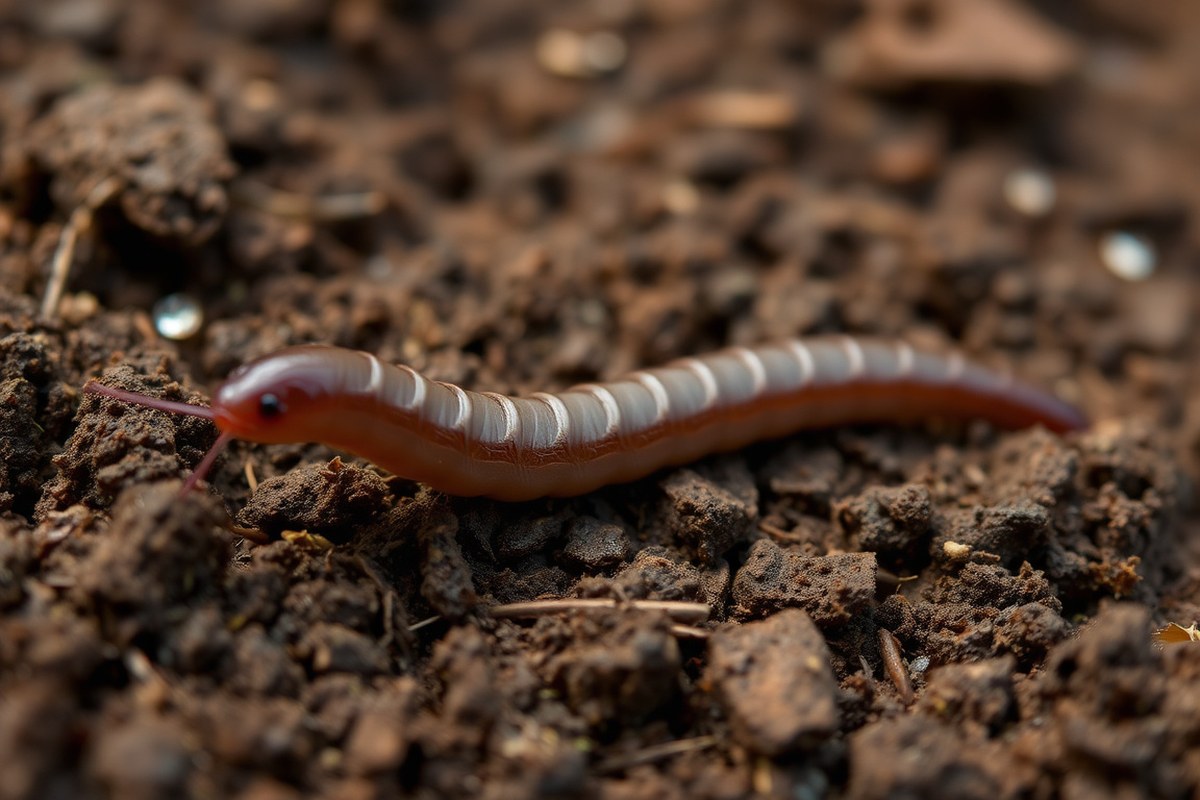
How many brains does a worm have? Worms have just one simple brain.
This brain contains about 300 neurons, just enough to control basic functions. It helps worms sense food and temperature changes in their surroundings.
You’ll notice worms don’t have eyes or ears, yet they navigate well underground. Their brain’s neurons react to touch and chemical signals in the soil. This setup is enough for their slow, constant search for food.
When you see worms with what looks like two brains, it’s often a misunderstanding. Worms have clusters of nerve cells in different body segments that can seem like separate brains. But these clusters work together as one system to control their bodies.
Key Takeaways
- A worm has one brain with around 300 neurons controlling basic survival tasks.
- Worm brains manage sensing food and temperature in their environment effectively.
- Worms lack eyes and ears but sense using chemical and physical signals.
- Nerve clusters in worm segments may seem like extra brains but are not.
- Worms use their brain to control simple reactions and find food underground.
- Despite a small brain, worms show memory and learning capabilities in research.
How Many Brains Does a Worm Actually Have?

Worms have one brain, but it looks very different from a human brain. The worm’s brain is the cerebral ganglion. It is a small group of nerve cells.
This ganglion is found at the worm’s front end. This ganglion controls simple sensory functions and coordinates movements.
Some people say earthworms have two brains. They have two cerebral ganglia. These ganglia are connected by nerve fibers.
However, these two parts work together as a single brain system rather than two separate brains. Each ganglion sits above the throat near the head, acting like one primitive control center.
Worms also have nerve clusters called ganglia in every body segment. These ganglia serve as local control points, managing muscles and reflexes along the body. Each segment controls its own movement.
This makes it seem like many brains exist. That is why the worm looks like it has multiple brains.
The worm’s nervous system runs a ventral nerve cord along its belly. This cord connects the cerebral ganglion to the rest of the body’s nerve centers.
The nerve cord sends signals from brain to muscles. It also sends signals from sense cells back to brain.
Knowing the worm’s brain is a cerebral ganglion shows it differs from the human brain. It has far fewer neurons, around 300 compared to billions in humans, and no protective skull. Still, this simple brain supports essential functions, like sensing food and temperature.
What Is the Structure and Function of Worm Brains?
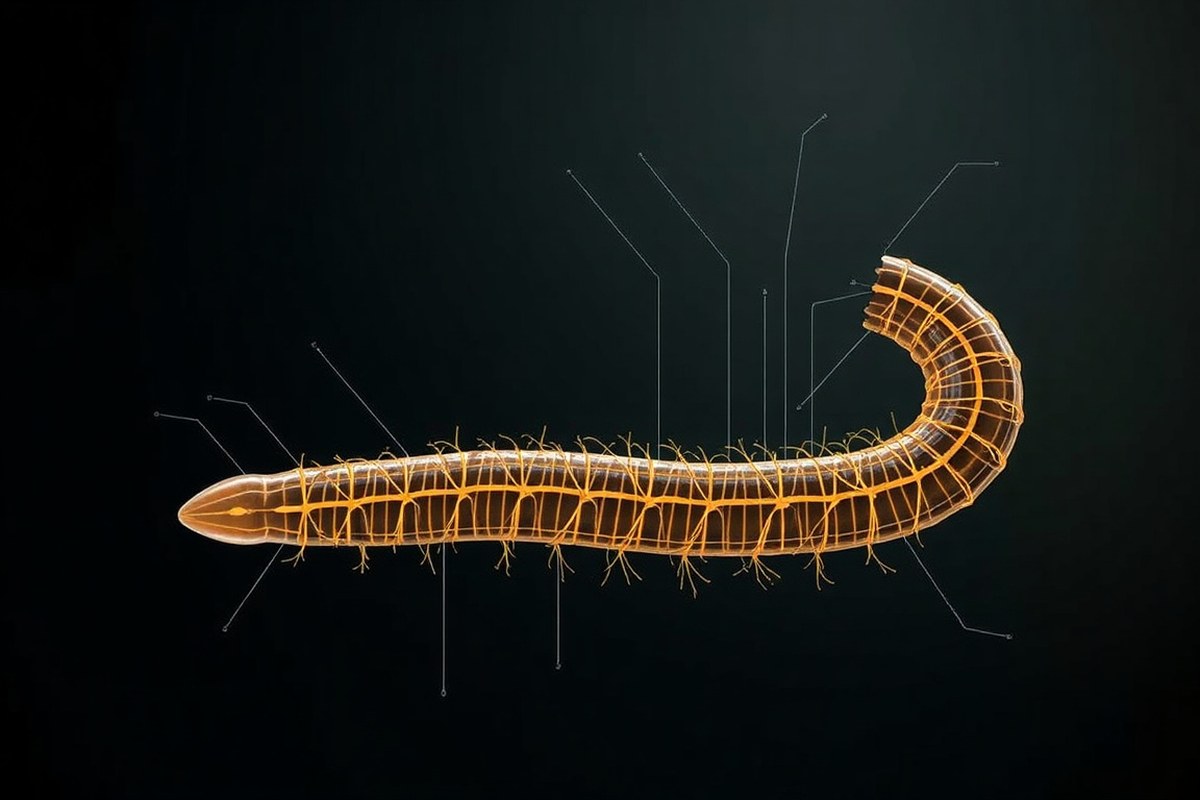
The worm brain is called the cerebral ganglion. This is a two-lobed cluster of nerve tissue.
It sits near the worm’s front, right above the pharynx. It is not located at the top of the head like a human brain.
The cerebral ganglion controls many body functions. It sends tiny electrical impulses when neurons fire.
These signals travel along large nerve fibers down the worm’s segmented body. This communication helps the worm move and respond to its environment.
Even with only 188 neurons in its brain, the worm manages complex tasks. The total nervous system in some worms, like C. Elegans, has 302 neurons.
Despite this small number, scientific mapping shows the brain performs many calculations per second. The brain connects to both sensory organs and motor neurons that control movement.
Here are key facts about worm brain structure and function:
| Feature | Description |
|---|---|
| Cerebral Ganglion | Two-lobed nerve tissue near the front, above the pharynx |
| Neuron Count (Brain) | About 188 neurons in the brain of C. Elegans |
| Total Neurons | 302 neurons in the entire nervous system for the adult worm |
| Communication Method | Electrical impulses sent through nerve fibers along the body |
| Location | Not at head top but near gut and other organs in front |
| Connectivity | Links sensory input to motor neurons for body control |
The worm brain doesn’t have a skull like humans. It relies on nerve bundles and large fibers to pass messages efficiently.
These messages help coordinate body segments despite injuries, since some segments work independently. This setup allows worms to react and survive even when the cerebral ganglion is damaged.
Handle worms gently; their nervous system is simple and easily disrupted by harsh conditions.
How Do Worms Sense Their Environment Without Eyes or Ears?
Worms use several sensing organs to explore their environment without eyes or ears. They detect light, chemicals, and touch with specialized cells instead. Their brains process this information to guide their movements and behavior quickly.
Photoreceptors and Light Sensitivity
Worms do not have eyes but have photoreceptors in their front body region. These cells sense light intensity changes. They help earthworms avoid bright surfaces.
Bright surfaces expose them to predators. Some simple light-sensing organs called ocelli sit on the worm’s anterior segment to detect light levels.
These photoreceptors allow worms to orient themselves under the soil or hide when light increases. Unlike complex eyes, these cells cannot form images but act as light detectors. They help the worm decide when to move deeper underground or come to the surface.
Chemoreceptors and Chemical Detection
Worms have chemoreceptors all over their skin. These help them smell chemicals in the soil. They also help with tasting.
These receptors detect chemical gradients like moisture and nutrients. This helps worms choose where to burrow or find food sources.
The worm’s brain receives signals from these chemoreceptors to assess the environment. That way, it can react and move toward better conditions or away from harmful substances. This chemical sensing is precise enough that scientists use worms to monitor soil quality.
- Chemo-sensitive cells all over the worm’s body
- Detect moisture, nutrients, and soil chemicals
- Help worms find food and suitable habitats
- Signal the brain to navigate away from threats
- Support environmental monitoring in research
The information from these chemoreceptors flows to the worm’s simple brain, which directs movement. Worm behavior relies heavily on this continuous chemical feedback loop.
Tactile and Vibration Sensors
Throughout their skin, worms have epidermal receptors that sense touch and pressure. These allow worms to feel obstacles and changes in soil texture. They also detect vibrations, warning the worm of nearby predators or environmental shifts.
The receptors communicate with the worm’s brain and segmental ganglia. The brain uses this input to adjust the worm’s speed and direction. This system helps worms move smoothly underground and escape danger fast.
Can Worms Learn and Remember? What Does Research Show?
Worms can learn from their experiences despite having only 302 neurons. The worm species Caenorhabditis elegans is the most studied for learning and memory.
They learn to ignore harmless or repeated stimuli and can make simple risk-reward choices. This shows worms form a basic, primitive memory.
Worm memory exists in different phases based on molecular signals. Short-term memory lasts about 30 minutes and uses calcium signaling pathways.
Intermediate memory lasts roughly an hour and relies on cyclic AMP molecules. After about two hours, the worm usually forgets, showing how memory fades naturally.
Research shows that making long-term memories in worms needs gene activity to produce new proteins. This process is similar to memory formation in animals like sea slugs and mice. The molecular basis behind these memories involves signaling pathways conserved across species, revealing fundamental brain functions.
Scientists study worm memory to understand how brains remember and forget. Worm brains can process pleasure and discomfort, hinting at a primitive form of feelings.
But worms can’t think or feel emotions like humans do. They mostly respond to sensory cues and learn what to avoid or seek out.
Worm learning and memory take place in neural circuits scientists model to help improve artificial intelligence. Worms show clear signs of memory lasting from minutes to hours during experiments. Damage to their brain structures can stop learning altogether because those parts control sensing and movement.
How Does Worm Brain Regeneration Work After Injury?
Worms can regrow parts of their nervous system, including their brain-like cerebral ganglion. This regrowth happens after injury, like when a worm is cut. The speed and success vary depending on the species and injury.
Stages of Nervous System Regeneration
Regeneration begins with wound healing, sealing off injured tissue. Next, cells near the injury divide and form new nervous tissue. Finally, neurons reconnect to restore nerve signals.
The process includes these key steps for nervous system regrowth:
- Seal the wound to prevent infection and loss of fluids.
- Activate stem-like cells to multiply and replace lost tissue.
- Differentiate new cells into neurons and support cells.
- Extend nerve fibers to reconnect damaged pathways.
- Re-establish synapses to resume nerve signal transmission.
- Test and strengthen new connections through behaviour and movement.
Timeline of Neuron Regrowth
Neurons near the injury start to regrow within hours to days. The first new nerve fibers often appear around 24 to 48 hours after damage. Full restoration of the cerebral ganglion and nerve networks can take several days to weeks.
Faster regeneration occurs in smaller or simpler worms. Larger species with complex nervous systems may require longer periods for full recovery.
Effects on Worm Behavior Post-Regeneration
After regrowth, worms often regain most normal functions like movement and environmental sensing. However, some lost skills can recover more slowly or only partially. Regeneration may temporarily disrupt learning and memory, but many worms eventually recover these abilities.
Damage to nerve centers farther from the brain tends to heal faster. The cerebral ganglion, being central, takes longer and is more vulnerable to functional loss during regrowth.
Worms need a clean, moist environment during healing to prevent infection and help regeneration.
Why Do Earthworms Sometimes Seem to Have Two Brains?
Earthworms don’t have two brains, but they do have many segmental nerve centers. These centers are called ganglia and sit in each body segment. They work like local control hubs, managing movement and reflexes in their own segment.
Each ganglion receives signals from sensory nerves and sends commands to muscles nearby. The worm’s ventral nerve cord connects all these ganglia in a chain. This setup lets worms move parts of their body even without signals from the head.
Worms have decentralized control in their nervous system. They can wriggle if body segments separate from the brain. This allows reactions without brain input.
Some people think worms have two brains or two heads. This idea is a myth.
Worms do not have duplicate brains or heads. The ganglia don’t replace the brain but support local actions.
This arrangement helps coordinate complex movements, like the waves of muscle contractions that propel the worm. It also allows quick responses, such as dropping body segments to escape predators. These decisions happen locally, without waiting for the main brain.
Scientists find worm nerve setups interesting. It shows how simple nervous systems control movement. It also explains some worm behaviors.
Understanding it could explain how nervous systems evolved from simple local controls to brains. But calling it two brains is misleading and ignores the real function of segmental ganglia.
How Are Worm Brains Influencing Robotics and Artificial Intelligence?
Worm brains, simple yet efficient, have inspired robotics and AI design. Their nerve systems show how smart actions can emerge without a central brain. This idea helps build robots and AI that use less energy and adapt better.
Worm Neural Efficiency in AI
The worm’s nervous system is highly efficient because it uses a decentralized design. Instead of a single brain controlling everything, many neurons work together locally. This model reduces the need for a “commander” and speeds up responses.
You can apply this to AI by creating neural networks that distribute tasks evenly. Rather than one processor handling all commands, AI can use smaller units that act independently. This approach lets AI handle complex tasks with fewer resources.
- Design AI architecture with no central control node
- Ensure neurons communicate locally to reduce processing delays
- Program units to handle specific sensory input independently
- Optimize for energy efficiency by limiting long-range signals
- Use sleep-like states in AI to save energy during idle times
Applying these steps helps AI systems become faster and more energy efficient. However, balancing local independence with overall coordination remains a key challenge.
Soft Robotics Inspired by Worm Movement
Engineers mimic worm movement to build soft robots that bend and crawl smoothly. These robots use flexible materials and simple control systems. They manage complex terrain without rigid joints or heavy motors.
The secret lies in replicating decentralized neural signals that lead to rhythmic muscle contractions. Robots don’t need a central brain to coordinate every step. This makes them resilient and capable of continuous movement, even with damage.
- Use soft, elastic materials for robot bodies
- Program segmented control mimicking worm neurons
- Build feedback loops for local segment adjustments
- Test robots on uneven or tight spaces
- Include simple sensors for environmental response
This design works especially well for search and rescue robots or medical devices. Robots using worm-like control can keep moving even if one part malfunctions.
Worm Connectomes in Computational Models
Scientists use worm connectomes, or nerve maps, as blueprints to design artificial neural networks. Worms have only 302 neurons, making their networks easier to study and simulate. This helps explore how neurons cooperate to process information.
Researchers program computers to track neuron signals quickly across many images. They try to replicate the way worm neurons interact. This work helps AI understand more about how networks adjust and learn.
- Map neural connections from worm brains for AI models
- Simulate signal flow across worm neuron networks
- Analyze network behavior under different stimuli
- Use worm models to test new learning algorithms
- Integrate findings into larger AI designs
Even though worm models don’t capture full brain complexity, they provide practical test beds. These models can challenge current AI assumptions and improve network designs.
How Does Worm Brain Complexity Compare Across Worm Species?
Not all worms share the same brain structure. Most annelids, like earthworms and marine worms, have a brain. This brain is called a cerebral ganglion.
It acts as a simple brain. However, size and complexity can vary among species.
Earthworms have relatively simple brains made mostly of clusters of nerve cells near their digestive organs. Marine worms, such as polychaetes, often have larger cerebral ganglia with more complex nerve networks. This allows them to process more sensory input from their often more variable environments.
Parasitic worms present unique nervous systems. Some worms have smaller or reduced brains. They depend on their host’s body a lot.
They do not need complex navigation or sensing. Others, like some nematodes, can move through mammal nervous systems.
This helps them complete their lifecycle. They have special adaptations for this.
The table below compares brain features, neuron counts, and nervous system arrangements of different worm types. It highlights how simple or elaborate their nervous systems get across several species.
| Worm Type | Brain Structure | Neuron Count (Approx.) | Nervous System Complexity |
|---|---|---|---|
| Earthworm (Annelid) | Simple cerebral ganglion beside organs | Thousands | Basic, mostly nerve clusters |
| Marine Worm (Polychaete) | Larger cerebral ganglia, segmented nerves | Tens of thousands | Complex, controls movement and senses |
| Nematode (e.g., C. Elegans) | Small brain with 302 neurons | 302 | Highly studied, simple but wired for precise actions |
| Parasitic Worm (e.g., tapeworm) | Reduced or simplified brain | Few thousand or less | Adapted for host dependency, simpler |
Marine worms tend to have more elaborate brains to handle their complex sensory worlds. Earthworms have fewer neurons because their shape and lifestyle require less sensory processing.
Parasitic worms often trade brain size for other traits. Their simpler nervous systems save energy, relying on the host environment. Scientists study these adaptations to learn how nervous systems evolve under different pressures.
Handle parasitic worms carefully, as some species can affect human nervous systems.
How to Observe and Understand Worm Brains Yourself
Try these simple steps to see worm behavior and learn about their nervous system. You’ll notice how worms respond and think without a typical brain.
- Day 1: Find a few earthworms in moist soil or garden beds. Pick gentle, small worms for easier handling.
- Day 2: Place a worm on a damp paper towel. Watch how it moves and reacts to touch or light changes.
- Day 3: Shine a flashlight near the worm’s head but not on it. Notice if the worm turns or moves away, showing sensory response.
- Week 1: Put some food (like a small leaf piece) near the worm. See if it moves toward the food, indicating simple learning.
- Week 2: Carefully pinch the worm’s tail and then release. Check if it shows quick backward movement, a reflex controlled by nerves.
- Week 3: Try a simple maze with damp soil. Place the worm inside and observe its path to find food or exit.
- After 1 Month: Compare different worms’ responses. Notice differences that may come from species or brain complexity.
Frequently Asked Questions
How Many Neurons Does a Worm’s Brain Typically Have?
A worm’s brain usually contains about 300 neurons. These cells handle sensory input and control simple behaviors.
They help worms find food and sense temperature. This shows their nervous system is basic but works well.
Do Worms Have Separate Nerve Centers in Each Body Segment?
Yes, each segment has its own small nerve center called a ganglion. This setup lets worms keep moving if part of their body breaks.
It explains why they seem to have multiple “brains.” The system is flexible like that.”
How Do Worm Brains Compare to Those of Other Simple Animals?
Worm brains share similarities with lobsters and snails. These comparisons help researchers study nervous system evolution across species with bilaterally symmetric bodies.
Can Worm Brains Think or Have Emotions Like Ours?
No, worms can’t think or feel emotions. Their brains process sensory information and control movement.
This shows a nervous system that is simple but essential. It handles basic life tasks well.
What Kind of Research Is Being Done on Worm Brains?
Scientists study worm brains to learn nervous system evolution and regeneration. This research also inspires developments in robotics and artificial intelligence.
Why Might Earthworms Appear to Have Two Brains?
Earthworms seem to have two brains because of their paired cerebral ganglia in the head. This dual structure helps coordinate movement and sensory processing efficiently.
The Bottom Line
Worms have one brain-like structure but many nerve centers controlling their body. Their simple nervous system helps them sense and react well. You can watch these smart actions yourself by paying attention to how worms move and respond.