How Many Gallons per Minute Is a Garden Hose? Your Complete Flow Rate Guide
Wondering how many gallons per minute is a garden hose? A standard garden hose usually delivers between 9 and 17 gallons per minute. Most 5/8-inch hoses flow around 12 to 13 gallons per minute at typical home water pressure.
Keep in mind, hose diameter, length, and water pressure change the flow a lot. Running your hose fully open uses about 10 gallons per minute. That adds up to 600 gallons every hour.
You use a lot of water this way. This number helps you estimate your water use when watering plants or washing outdoors.
Check your hose diameter and water pressure if the flow seems too low. These two factors matter most for getting the right water volume to your garden. Measuring actual flow lets you plan watering times and prevent waste.
Key Takeaways
- A 5/8-inch garden hose typically flows 12 to 13 gallons per minute at home pressure.
- Hose diameter strongly affects flow; smaller hoses deliver less water per minute.
- Longer hoses reduce flow due to friction inside the hose tubing.
- Water pressure in your home system directly impacts how fast water flows out.
- Running the hose fully open usually results in about 10 gallons per minute flow.
- Use a bucket and timer to measure your hose’s flow rate accurately.
How Many Gallons per Minute Does a Standard Garden Hose Deliver?
The typical garden hose flow rate depends on its diameter and pressure. A common 5/8-inch hose usually delivers between 9 and 17 gallons per minute (GPM).
This range equals about 34 to 64 liters per minute. It covers most home watering needs.
Smaller hoses, like 1/2-inch diameter, often provide 4 to 12 GPM (15 to 45 LPM). They work well for hand watering and shorter runs. Larger hoses, like 3/4-inch diameter, push water faster.
They reach 17 to 23 GPM (64 to 87 LPM). This higher flow is handy when you need to fill large containers quickly.
The table below compares common hose sizes against their flow rates at typical household water pressure:
| Hose Diameter | Typical Flow Rate (GPM) | Typical Flow Rate (LPM) | Use Case |
|---|---|---|---|
| 1/2 inch | 4, 12 | 15, 45 | Hand watering, short runs |
| 5/8 inch | 9, 17 | 34, 64 | Most home watering tasks |
| 3/4 inch | 17, 23 | 64, 87 | Filling large containers, high volume |
Knowing your hose’s flow rate helps you plan watering times and water usage. A 5/8-inch hose running at 12 GPM uses 720 gallons per hour. Differences in your local water pressure or hose length can shift these numbers.
A smaller diameter usually means less flow, slower watering, and longer fill times. Larger diameters move more water but need more pressure to keep flow steady. Balancing hose size and your watering tasks ensures efficient use without wasting water or time.
Which Factors Affect Garden Hose Flow Rate Most?
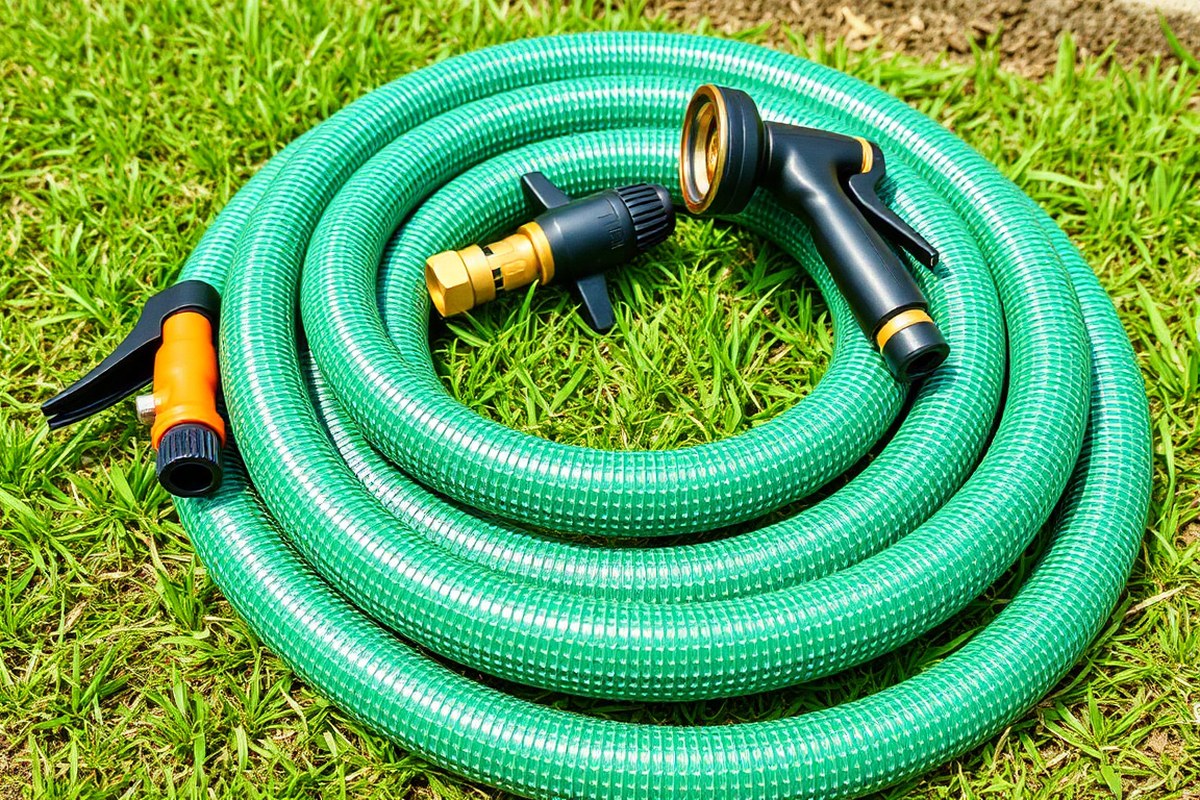
Several key factors shape how much water flows through your garden hose each minute. Hose diameter, water pressure, and hose length all directly affect gallons per minute (GPM). Attachments like nozzles and fittings can reduce flow by creating blockages or extra friction.
Hose Diameter and Its Impact on Flow
The hose diameter sets the maximum water volume that can pass through. A common 5/8-inch hose typically delivers between 5 and 10 GPM depending on pressure. Smaller diameters like 1/2 inch lower the water flow rate.
They often reduce it to around 6 GPM at 40 psi across 100 feet. This means less water pressure and slower watering.
Using a wider hose, such as 3/4 inch, increases flow. This gives you more gallons per minute through the hose. It helps water your garden faster and easier.
However, thicker hoses cost more and can be heavier to handle. Match hose size to your watering needs and water pressure for best results.
How Water Pressure Influences Flow Rate
Water pressure from your supply pushes the water through the hose and determines speed. A higher PSI increases gallons per minute but only up to the hose’s diameter limit. Typical home pressure ranges from 40 to 60 pounds per square inch.
Low water pressure means slower flow and longer watering times. You can measure pressure with an inexpensive gauge at the faucet. Check city water supply or leaks if pressure is low before replacing your hose.
Hose Length and Flow Reduction Explained
Longer hoses experience more resistance, lowering the flow rate. Water moves slower in a 100-foot hose than a 25-foot hose at the same pressure. The longer length causes more resistance.
This lowers flow speed and watering efficiency. This happens because water rubs against the hose’s interior walls, causing friction loss.
Choosing a shorter hose reduces friction loss and improves flow. Choose a hose with a larger diameter if you need a longer length for your garden. Avoid unnecessary length to maintain better water pressure and faster delivery.
Nozzles, Fittings, and Flow Restrictions
Nozzles and connectors narrow the water path, which can cut flow by a third or more. Some nozzles save water by limiting flow rate.
They help control water use but slow down watering speed. Misaligned or damaged fittings add extra resistance as well.
To keep high flow, pick nozzles with larger openings or adjustable settings. Remove debris or mineral buildup inside fittings if water slows unusually. Using quick-connects with a smooth interior can also reduce flow loss.
Friction Loss and Its Role in Water Flow
Friction loss occurs inside the hose when water rubs against its walls as it moves. This loss increases with longer hoses, smaller diameters, and rough interior hose surfaces. It reduces pressure and gallons per minute at the hose end.
The Hazen-Williams equation estimates this loss based on hose size, length, and pressure. Avoid kinks and sharp bends to reduce friction. Replacing old hoses with smoother interior linings can restore better flow too.
Keep your hose straight and free from kinks to avoid unnecessary friction and flow loss.
How to Measure Your Garden Hose Flow Rate Accurately
Measuring your garden hose flow rate is easy with a bucket and a timer. You fill the bucket, time how long it takes, and then do simple math. This helps you know how much water your hose delivers per minute.
Gather Required Tools
You only need a few things to measure your hose flow accurately. Get a 5-gallon bucket, a stopwatch or timer, and your garden hose. An optional funnel can help if your hose end doesn’t fit the bucket well.
These items cost little or nothing if you already garden. The bucket size matters because five gallons is easy to measure and standard for flow tests. The timer must be precise to seconds for better accuracy.
Perform the Bucket Fill Test
Start by fully opening the hose so water flows freely. Place the bucket where the hose end reaches comfortably. Use your timer to track how long it takes the bucket to fill.
Follow these steps to get the test done right:
- Connect the garden hose to your outdoor faucet and turn it on fully.
- Place the 5-gallon bucket on a stable surface under the hose opening.
- Start your stopwatch as soon as water begins to flow into the bucket.
- Stop the timer when the bucket reaches the 5-gallon mark or fills completely.
- Note the time it took to fill the bucket in seconds.
Make sure the hose is open wide during the test to measure its full flow. You might want to do the test twice and average the times for accuracy.
Calculate Flow Rate from Results
To find gallons per minute (GPM), divide the bucket size by the fill time in minutes. For example, if you took 30 seconds (0.5 minutes) to fill 5 gallons, then 5 ÷ 0.5 = 10 GPM.
This result tells you how many gallons your hose delivers each minute at full flow. Compare your results to typical numbers: 10 GPM is average for a 5/8-inch hose.
If the time is longer, like 60 seconds, your flow rate drops to about 5 GPM, which means slower watering. That could mean a kinked hose, nozzle restriction, or low water pressure.
Typical Flow Rates by Hose Diameter, Length, and Pressure
Water pressure and hose diameter affect the flow rate of garden hoses. A 1/2-inch hose generally delivers less water than 5/8- or 3/4-inch hoses. The flow rate drops as the hose gets longer.
Water meets more resistance moving through longer hoses. That reduces how much water flows out.
Here is a table showing how flow rates vary by hose diameter and pressure. These numbers come from typical household water systems.
Keep in mind that flow rates get lower as hose length increases. But those details depend on your specific hose and water source.
| Hose Diameter (inches) | Water Pressure (PSI) | Flow Rate (Gallons Per Minute) | Flow Rate (Liters Per Minute) |
|---|---|---|---|
| 1/2 | 20 | 2.5, 4.0 | 9.5, 15.1 |
| 1/2 | 40 | 4.0, 6.5 | 15.1, 24.6 |
| 1/2 | 60 | 5.0, 8.0 | 18.9, 30.3 |
| 1/2 | 80 | 6.0, 9.5 | 22.7, 36.0 |
| 5/8 | , | 17 | , |
| 3/4 | , | 22 | , |
Expect about 9 GPM with a 1/2-inch hose. A 5/8-inch hose gives around 17 GPM. A 3/4-inch hose offers about 22 GPM.
These numbers rise with higher water pressure. Raising pressure from 20 to 60 PSI more than doubles flow.
This happens with a 1/2-inch hose. Higher pressure pushes water faster through pipes.
Longer hoses cause flow rates to drop because water loses pressure over distance. Adding 50 or 100 feet can lower your output noticeably. To keep good flow, pick a wider hose or shorter length if your pressure is low.
How to Calculate Water Usage over Time from Hose Flow Rate
Convert Gallons per Minute to Gallons per Hour
Multiply your hose’s gallons per minute (GPM) by 60 to get gallons per hour. For example, if your hose flows at 8 GPM, multiply 8 by 60. This equals 480 gallons per hour, showing how much water runs through in one hour.
Knowing gallons per hour helps plan watering sessions better. It’s useful for large areas that need steady water supply for an hour or more.
Calculate Time to Fill a 5-Gallon Bucket
Fill a 5-gallon bucket and time how long it takes in seconds. Divide 5 gallons by that time in seconds to find flow rate in gallons per second. Then multiply by 60 to get GPM.
For example, if filling takes 15 seconds, 5 ÷ 15 equals 0.33 gallons per second. Multiply 0.33 by 60 to get 20 GPM. To find bucket filling time from GPM, divide 5 gallons by GPM, then multiply by 60.
Estimate Filling Times for Swimming Pools
Find the pool’s total gallons it holds before filling. Divide pool gallons by hose GPM to get minutes required. Multiply minutes by 60 to convert to seconds if needed.
If your pool holds 12,000 gallons and your hose flows at 10 GPM, 12,000 ÷ 10 equals 1,200 minutes to fill. That’s 20 hours. Knowing this helps avoid overwatering and plan pool use.
Convert Gallons to Liters and Minutes to Hours
Use 1 gallon = 3.785 liters to convert gallons to liters. Multiply gallons per minute by 3.785 to find liters per minute. To get liters per hour, multiply liters per minute by 60.
For example, 8 GPM equals 8 × 3.785 or 30.28 liters per minute. That multiplies to 30.28 × 60, or 1,817 liters per hour. This helps if measurements or equipment use liters instead of gallons.
Practical Tip for Accurate Measurements
Measure flow rates with the hose running at your usual water pressure. Flow changes when you add nozzles or if pressure drops.
Choosing the Right Hose Diameter for Your Watering Needs
Choosing the right hose diameter depends on your garden size and watering needs. A 5/8-inch hose works best for medium-sized gardens. It lets about 17 gallons per minute flow.
This speed balances watering well. Handling and storage stay easy with this rate.
For large gardens or quick watering jobs, pick a 3/4-inch hose. It delivers around 23 gallons per minute.
This wider hose works well if you want to fill pools or water big areas fast. But it’s heavier and harder to coil.
Smaller gardens or container plants suit a 1/2-inch hose. It flows about 9 gallons per minute. This size is lighter and easier to control but slower for big watering tasks.
- Small gardens: choose 1/2-inch hose for light watering.
- Medium gardens: use 5/8-inch hose for balanced flow and ease.
- Large gardens: select 3/4-inch hose for fast, high-volume watering.
- Filling large containers? Go with 3/4-inch hose for speed.
- Need portability and less weight? Stick with 1/2-inch or 5/8-inch hoses.
The wider the hose, the faster water flows, but also harder to handle. You want enough flow to cover your garden without struggling to move the hose. Think about your garden’s size before picking a hose.
Do you want ease or speed more? This helps you decide quickly.
Costs rise slightly with wider hoses. A 3/4-inch hose may cost 20-30% more than a 5/8-inch one. Thicker hoses take up more storage space.
That can be a problem. Limited room makes this an important factor.
How Nozzle Types and Attachments Influence Garden Hose Flow
Nozzles usually reduce your garden hose’s water flow. They narrow the stream, raising pressure but cutting gallons per minute. For example, a 5-gallon-per-minute hose might flow only 3 gallons once you add a spray nozzle.
Different nozzle types change how water moves through the hose. A simple twist nozzle can squeeze water to a thin jet or spread it wide. This lowers flow at a narrow jet and increases coverage at a wide spray.
Spray patterns matter a lot when saving water. A mist or shower setting uses less water than a full jet. Pick a wide spray to cover plants gently and avoid waste.
Attachments like oscillating sprinklers can slow flow, too. They split water into small streams and often run slower than a bare hose. This helps avoid flooding but can extend watering time.
Nozzles boost pressure by pushing water through smaller openings. While pressure feels stronger, the actual water volume drops.
This helps if you need reach, like watering tall trees. But it doesn’t increase how much water you use.
Use the nozzle’s off setting to stop water flow without going back to the faucet. This saves water during breaks. Also, clean or replace nozzles clogged with dirt to keep consistent flow.
Choosing the right nozzle costs between $5 and $20. Cheaper models have fewer spray options but still affect flow. Higher-end nozzles offer multiple patterns with better flow control.
Keep hose leaks or kinks in mind when evaluating nozzle flow. Even the best nozzle won’t fix low flow caused by a damaged hose. Fix or replace hoses to get the best result from your nozzle.
To test how a nozzle changes flow, measure water output without it, then with it attached. Use a bucket and stopwatch. This shows gallons per minute lost or saved when adjusting spray patterns.
Common Mistakes and How to Troubleshoot Low Hose Flow
Low water flow often happens because your hose has a kink or blockage. Kinks stop water from flowing right through the hose. They cause a drop in water pressure at the hose bib.
This means less water comes out than it should. Checking and fixing these issues can improve flow without replacing the hose.
Start by inspecting your garden hose from start to end. Feel along the entire hose for sharp bends or flattened sections. Straighten out any kinks you find and then turn on the water.
Flow gets better when the kink is gone. That shows the kink caused the trouble.
Blockages can come from dirt, debris, or mineral buildup inside the fittings or hose. Try detaching the hose from the faucet and nozzle. Run water through the hose without the nozzle attached.
Flow stays weak? Try cleaning the hose or fittings. Flush them with water or clear blockages with a thin wire.
- Look for cracks, holes, or soft spots in the hose material
- Check hose couplings and connectors for rust, damage, or tightness
- Run water through the hose without attachments to isolate the problem
- Flush fittings and hose ends to remove debris and buildup
- Replace damaged sections or the entire hose if leaks or wear show
Notice cracks, leaks, or rust on your hose or fittings? Think about fixing or replacing them soon. Small holes might patch with a hose repair kit costing $10 to $20.
But widespread damage means buying a new hose. New hoses usually range from $20 to over $50 depending on length and diameter.
Water pressure at the faucet changes when you turn on your hose. Make sure your home’s main water pressure is normal. Low pressure means low flow, and no hose repair will fix that.
Pressure still feels low? Check other water spots in the house. You might need to call a plumber.
Never force a hose to straighten while water is running. You could damage it more.
Step-by-Step Action Plan to Optimize Your Garden Hose Flow
Use this plan to find and improve your garden hose’s water flow. Follow each step and check your flow rate as you go to see results.
- Before You Start: Measure your current hose flow using a bucket and a timer. Note how many gallons per minute come out to have a baseline.
- Day 1: Clean your hose and nozzle to remove any clogs. Check if the flow rate improves compared to your baseline.
- Day 2: Test different nozzle types or remove attachments. See if changing these increases your water flow noticeably.
- Day 3: Replace your hose with a wider diameter model if flow is still low. Re-measure flow to confirm better performance.
- Day 4: Inspect your water source pressure with a pressure gauge. Adjust your schedule to water when pressure is highest, typically early morning.
- Week 1: Track how long you water each time. Measure your hose flow rate. Then calculate your total water use. Compare it to your garden needs to avoid waste.
- After 2 Weeks: Monitor hose flow regularly for blockages or leaks. Take action if flow drops again to keep your system efficient.
Frequently Asked Questions
How Many Gallons per Minute Does a Garden Hose Typically Deliver?
A standard garden hose delivers 9 to 17 gallons per minute. This depends on the hose diameter and water pressure.
Both factors change how much water flows through. Most 5/8-inch hoses run about 12 to 13 gallons per minute at home water pressure.
What Causes the Flow Rate of a Garden Hose to Vary?
Hose diameter, hose length, water pressure, and the type of nozzle all affect flow rate. Longer or narrower hoses usually have less water flow.
How Do You Measure the Flow Rate of a Garden Hose Accurately?
To measure flow, fill a container of known volume and time how long that takes. Divide the gallons by minutes to get gallons per minute.
What Is the Average Flow Rate of a 5/8-inch Garden Hose?
A 5/8-inch garden hose typically flows about 17 gallons per minute when running wide open. This diameter is common for general garden use.
How Does a Garden Hose Nozzle Affect Gallons per Minute?
Nozzle types can reduce water flow significantly by restricting the opening. High-pressure nozzles lower GPM but increase spray power.
What Is a Quick Way to Guess Water Usage over Time with a Garden Hose?
Multiply the hose’s flow rate by minutes used for gallons consumed. For example, 10 gallons per minute times 60 minutes equals 600 gallons per hour.
Before You Go
A garden hose usually flows 5 to 10 gallons per minute. It depends on size and water pressure. You can check your hose size for a better idea.
Measuring your flow helps you use water wisely. Time how long it takes to fill a bucket.
This helps you find your exact flow rate. Use a bucket with a known gallon size.